An operator portal for last-minute discount management.

Hot Tickets is a marketplace I co-founded that connects travellers with last-minute discounted tours in Iceland. Things like whale watching, glacier hikes, northern lights tours. To grow, we needed to give tour operators a way to manage discounts on their own.

I designed this operator portal to show investors what we wanted to build, not just describe it. The case study focuses on the discount creation flow, the most critical and uncertain part of the system. The rest of the portal leaned on established patterns.

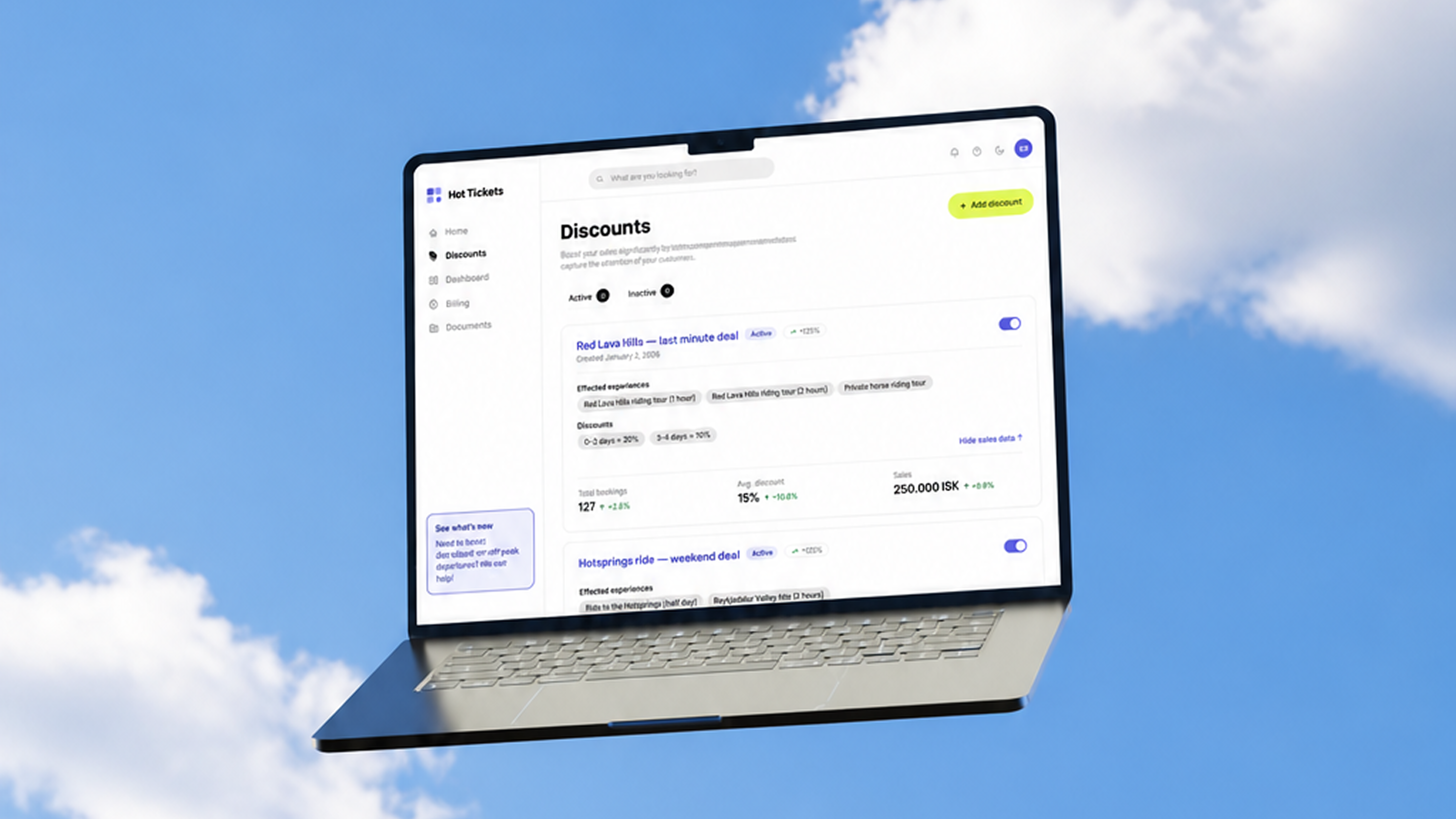
A first look at the operator portal.

Why Hot Tickets needed its own portal.

Hot Tickets relied on Bókun, the industry-standard booking platform, for availability and inventory. Discounts were the core of our business model, but they had to be configured inside Bókun's tooling. The setup was confusing for non-technical operators and often required hands-on support.

It worked at small scale. But as we looked to expand into new markets, it became a clear bottleneck. We needed a dedicated portal we controlled.

To fund building it, we went to investors. I designed the portal so we could show them how it would work, not just describe it. The round didn't fully close and the portal never shipped. The design still reflects real business constraints, real operator needs, and a real product strategy.

Goals

  • Enable self-service discount setup for non-technical operators
  • Reduce onboarding friction and the need for hands-on support
  • Give operators clear visibility into how their discounts perform
  • Support expansion into new markets

Constraints

  • Bókun remained the system of record for inventory and bookings
  • Integration had to work within Bókun's API limitations
  • Limited development resources required pragmatic scope decisions

Understanding the domain before designing.

Research had two jobs. Make sure the portal would cover what operators actually need, and surface the areas where deeper design work was required.

I clustered the product into topic areas (discounting, onboarding, reporting, admin, payments) so research would cover the full scope of the portal, not just the parts I assumed mattered most.

From running Hot Tickets I already understood much of the operator workflow. I mapped what I knew against what still needed checking, so research could focus on the real gaps.

The "need to learn" column from the previous step became the questions research had to answer. Especially around how operators think about discounts, where setup breaks down, and what reporting they actually want.

I interviewed three tour operators with different business profiles to represent the range of Hot Tickets partners.

This was supported by ongoing observation from real onboarding sessions, support conversations, and hands-on use of Bókun to understand existing workflows and technical constraints.

Choosing where to go deep.

Coming out of UX studies at Hyper Island, my instinct was to apply the Double Diamond to the entire product. After research, I mapped the portal out as a set of flows and started running each one through the process.

It quickly became clear that didn't fit. The Double Diamond is built for unknowns, for problems that need discovery, definition, and ideation. But most flows in the portal (sign-up, dashboards, navigation, reporting, admin) already have well-established answers. They just needed to be designed well.

The discount creation flow was different. It was the core business mechanic, the biggest source of operator confusion, and where research surfaced the strongest insight. It was also what investors needed to see, because it was what made the company make sense.

So I scoped the deep design work to that flow. The rest of this case study focuses on it.
Operators already know how they want to discount. They just can't easily express it.

Across interviews, the same pattern came up. Operators don't struggle to decide when to discount. They think in rules:

"If we're within 24 hours of departure and still have 3+ seats, drop 25%."

— Tour operator

"If a glacier hike is under 60% booked 48 hours out, discount everything in that category."

— Tour operator

"If I could just log in and say: apply 25% off to tours within 24 hours if we still have 3 or more spots, that would be amazing."

— Tour operator

They make these calls every day, based on time to departure, seats remaining, weather, and demand. The problem wasn't the logic. It was translating that logic into clunky, manual tools, every day, for every tour.

How might we help operators turn their pricing logic into flexible rules they can set once and trust to run?

From insight to interface.

The insight pointed directly at the solution: rules. Instead of editing prices tour by tour, operators would build conditional rules. Set the conditions, set the discount, let it run.

I worked the flow through ideation, task flows, user flows, and wireframes before landing on the final design.

Ideation sketches
Ideation I started by ideating against the HMW. Operators wanted to discount on time to departure, seats remaining, day of the week, and tour category, sometimes layered together. The breadth of cases shaped everything that followed.
Task flow diagram
Task flow I then mapped the discount creation flow as a single task flow. No matter how complex the rule, it always followed the same five steps: select tours, define conditions, set the discount, review, save.
User flow with branching logic
User flow From the task flow, I built a more detailed user flow that handled the branching logic. Single experience versus multiple, special rules, returning to add another.
Lo-fi wireframes
Lo-fi wireframes Lo-fi wireframes let me test the layout fast. I sketched the screens on paper to see how the flow felt step by step before committing to detail.
Hi-fi wireframes
Hi-fi wireframes Hi-fi wireframes brought the flow to life. The final structure mirrors the rule-based thinking that came up in research: name it, define conditions, set the discount, review, save.

The discount flow.

The screens below walk through the full discount creation flow. From an empty portal to creating rules, configuring experiences, and managing live discounts. The rest of the portal followed standard patterns and is not shown here.